What is Community Health?
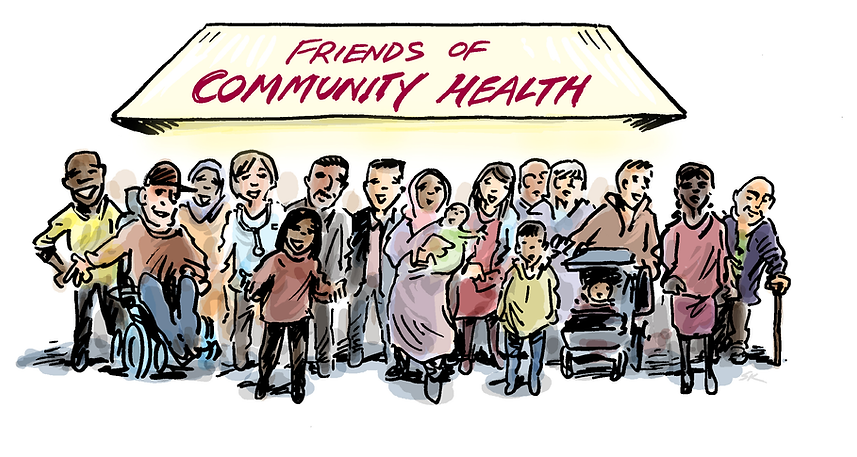
Community Health is both an ideal about how our health system should work, and in Victoria, a group of 79 community-based services that demonstrate what this looks like in every-day health care.
What does a Community Health Service (CHS) team look like?
They vary widely from small services to large multisite organisations. A CHS may include doctors, allied health workers, community nurses and social workers, maybe a psychologist, sometimes the council-employed infant welfare nurse or other social support or specialist services.
Working under the same roof, there is better teamwork and continuity of care for patients and service users.
Become a ‘Friend of Community Health’
-
Create a ‘Friends’ group in your neighbourhood/town/suburb/CHS
-
If you’re a member of a CHS Board of Management, make sure your fellow board members join you as a ‘Friend’ (of CH)
-
If you’re a GP or other clinician who’s fed up with corporate ownership rules and profit motives, become a ‘Friend’ and/or consider working in a CHS
-
If you live outside Victoria, join us to persuade the Commonwealth to consider CHSs as the best way to provide affordable primary care under Medicare
-
Write or visit your local member of Parliament and give them a copy of the briefing sheet (linked below)
So, it’s like a ‘multi-disciplinary GP clinic’ then?
Well, no…and the differences are important:
-
Community health services (CHS) are not-for-profit while GP clinics are increasingly owned by for-profit corporations
-
CHSs bulk-bill medical services, and keep any out-of-pocket costs low; GPs are under pressure from owners to cover their costs AND make a profit
-
GPs most often refer patients to outside physios, psychologists, etc. rather forming a team in the practice
What else makes them different?
-
Community: most CHS have community advisory boards, some even elect their board of management from their membership
-
Special attention to under-served members of a community: for example, low income or recently-arrived migrants
-
Health promotion that focusses on social determinants of health and supports community improvement not just individual lifestyle changes
-
Understanding the local area in which they operate and responding and advocating in response to those needs
-
Programs of community connection in addition to direct care.
But the care is pretty much like a GP clinic?
Well, yes and no…again the differences are important:
CHS understand that many things can affect people’s health:
-
How wealthy people are
-
Their education
-
Their housing or homelessness
-
Trauma in childhood
-
Lack of family and social support networks
-
Feeling like you belong or are excluded in your community
For over 50 years, these ‘social determinants of health’ have formed the basis of CHS care. Some for-profit GPs understand their importance, but medical schools have been slow to include them in doctor training.
Towards the ideal health system
CHS have long advocated principles such as:
-
Participation
-
Accountability
-
Non-discrimination/equality
-
Fairness
-
Respect
-
Dignity
-
Autonomy/patient rights
Health systems in Ireland and Scotland have formally adopted this ‘human rights approach’ to health care.
These principles are core to the philosophy of the care CHSs provide, even if they don’t always get it right.
Medicare was meant to ensure that no one is denied care because they can’t pay, yet out-of-pocket costs mean many can no longer afford primary care.
CHS are not mini-hospitals, they are focussed on supporting health in the community.
A ‘platform’ for primary health care
-
The COVID pandemic taught us that community trust in health information and services is essential
-
Ad hoc funding of specific kinds of community-based services just repeats the old ‘siloed’ nature of separate services for each new health ‘crisis’—there needs to be a flexible platform for governments to build new services on and around
-
Fee for service is not the right model; adding more health professional groups onto the fee schedule will only create more opportunities for out-of-pocket charges for patients—as is the case for fee for service GPs at the moment.
-
The CHS model does most of the things policy-makers seek: generalist not siloed services, continuity of multidisciplinary care, and good access to affordable health care.
Why now?
Victoria’s CHSs are always under financial stress and are not funded for the full range of services they already provide or could potentially provide in future. The cohealth Board’s lack of accountability for closing services shows up the failings of self-appointed boards and funding through competitive bidding.
The Commonwealth government is seeking ‘reforms’ of the primary health care system, and Victoria is the only state that still has a functioning system of CHSs to demonstrate what our health system could become.
If not now, when? Will Victoria be the last outpost of a better kind of primary medical and health care?